
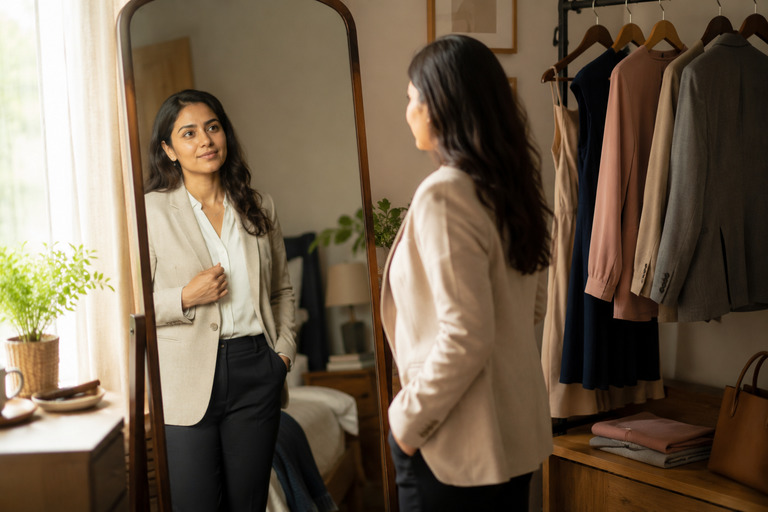
Life changes before the wardrobe does.
A new role, a return to work, marriage, motherhood, relocation, recovery, retirement or a significant personal shift can alter how a person lives and how they see themselves.
The clothes may still fit, yet feel disconnected.
Others may belong to an earlier routine, identity or level of responsibility. The difficulty is not always deciding what to buy. It is understanding what now feels relevant.
The wardrobe often carries an earlier version of life
Clothes hold memory.
They may represent a former workplace, a different body, another social life or a period when priorities were not the same.
This can make wardrobe decisions unexpectedly emotional. Letting go of something may feel like letting go of the person who wore it.
There is no need to reject that earlier version of yourself. But the wardrobe should not prevent the present one from being seen.
A useful wardrobe reflects the life being lived now.
Change creates practical questions
Different transitions create different requirements.
Returning to work may require clothes that support confidence after time away. A more senior position may bring greater visibility and formality. Parenthood may make comfort, movement and simplicity more important. A relocation may introduce a new climate or social environment.
Before changing the wardrobe, consider:
- What does an ordinary week now look like?
- Which situations require greater confidence?
- What no longer feels natural?
- Which clothes still represent you?
- Where does the current wardrobe make life harder?
These questions reveal what needs to change without turning the process into complete reinvention.
Start with what still feels right
A new phase does not require discarding everything.
Some pieces may continue to work because they reflect lasting preferences rather than temporary circumstances. A favourite colour, a particular silhouette or a way of combining clothes may still feel entirely appropriate.
Keep what remains useful, comfortable and personally meaningful.
This creates continuity. It also prevents the new wardrobe from feeling like a costume designed for a role rather than a natural evolution.
Allow your preferences to change
People often continue dressing according to rules they formed years earlier.
They may avoid colours they once believed did not suit them, repeat silhouettes that no longer feel comfortable or maintain a level of formality that belongs to a previous environment.
A life transition is an opportunity to question these habits.
You may now prefer cleaner lines, softer fabrics, stronger colour or greater simplicity. You may want to appear more visible or less formal. These changes do not mean your earlier choices were wrong.
They simply reflect a different point in life.
Dress for the body you have now
Physical change can make dressing difficult, particularly when clothes are used as reminders of a former body.
Waiting to return to an earlier size often leaves the present wardrobe incomplete and discouraging.
Clothes should support the body as it is today.
This means choosing fit, proportion and fabric without treating the current body as temporary or inadequate. Well-fitting clothes improve movement, posture and comfort immediately.
Respecting the present body is not the end of personal ambition. It is the beginning of dressing with accuracy.
Build for the life you actually live
A wardrobe can become aspirational in the wrong way.
It may contain clothes for dinners that rarely happen, formal events that are uncommon or a working routine that no longer exists. Meanwhile, the situations faced every week remain unsupported.
Begin with the most frequent parts of life.
Create reliable combinations for regular workdays, social occasions, family responsibilities and moments that carry greater visibility. Once these are covered, occasional pieces can be added with more judgement.
The wardrobe should serve reality before fantasy.
Do not rush to fill every gap
Transitions can create urgency.
It may feel necessary to replace the entire wardrobe quickly so the new phase appears complete. This often leads to expensive choices made before preferences and requirements are fully understood.
Begin with a small number of dependable pieces.
Wear them. Notice what works. Observe what still feels absent.
A wardrobe built gradually is more likely to reflect the person accurately because the decisions are informed by real experience rather than anticipation.
Confidence may need time to catch up
A new role or identity can feel unfamiliar even when it is positive.
Someone returning to professional life may still feel uncertain in formal clothes. A newly promoted leader may feel over-dressed when adopting greater structure. A person rebuilding life after change may not immediately know how visible they want to be.
Clothing cannot resolve every uncertainty, but it can create useful support.
The right clothes reduce hesitation. They make preparation easier and allow attention to move towards the day ahead.
Starting again does not mean starting from nothing
Personal style is not erased by change.
It develops through it.
The colours, shapes and details that have always felt natural can remain. What changes is the way they are interpreted for a different life.
The aim is not to construct a completely new identity. It is to create enough room for growth without losing the thread of who you have been.
A wardrobe for a new life stage should feel current, capable and recognisable.
It should not announce that you have become someone else.
It should quietly show that you are ready for what comes next.